ACORD 25 Parsing: Manual vs AI Comparison
Insurance certificate processing is a critical function for businesses that manage vendor relationships. At the center of this process is the ACORD 25 form, the industry standard for certificates of liability insurance. ACORD 25 parsing refers to the extraction of key data points from these certificates, and today, organizations face a choice between manual and AI-driven approaches. This comparison will help you understand which ACORD 25 parsing method best suits your organization's needs, efficiency goals, and compliance requirements.
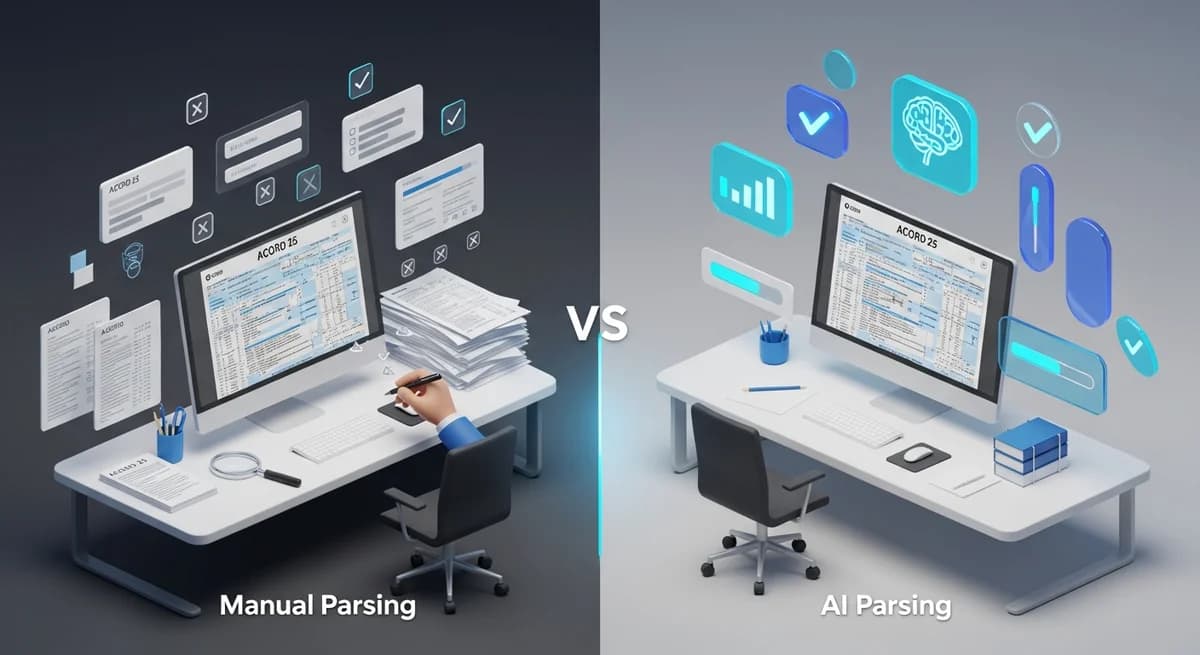
ACORD 25 Parsing: Manual vs AI Comparison
Insurance certificate processing is a critical function for businesses that manage vendor relationships. At the center of this process is the ACORD 25 form, the industry standard for certificates of liability insurance. ACORD 25 parsing refers to the extraction of key data points from these certificates, and today, organizations face a choice between manual and AI-driven approaches. This comparison will help you understand which ACORD 25 parsing method best suits your organization's needs, efficiency goals, and compliance requirements.
Manual ACORD 25 Parsing: An Overview
Manual ACORD 25 parsing involves human operators reviewing each certificate of insurance, identifying key information fields, and manually entering that data into tracking systems. This traditional approach has been the standard method for decades in the insurance industry.
The Manual Process Workflow
When certificates arrive (typically via email or physical mail), staff members must:
Review each ACORD 25 certificate
Identify required information (policyholder details, coverage types, limits, effective dates, etc.)
Manually input this data into a tracking system or spreadsheet
Verify compliance with contractual requirements
Flag deficiencies and follow up with vendors
Set up expiration alerts and manage renewals
This labor-intensive process relies heavily on human attention to detail and insurance knowledge to accurately interpret and record the information contained in ACORD 25 certificates.
AI-Powered ACORD 25 Parsing: An Overview
AI-powered ACORD 25 parsing leverages advanced technologies like optical character recognition (OCR), machine learning, and natural language processing to automate the extraction of data from certificates of insurance. These systems can process certificates in various formats, including PDFs, scanned images, and even photographs.
The AI Parsing Workflow
When implementing AI-based ACORD 25 parsing, the typical process includes:
Certificate intake through digital channels (email forwarding, upload portals, or API integrations)
AI processing to identify and extract key data points (typically 50+ fields)
Automated compliance checking against predefined requirements
Exception flagging for human review when needed
Automated notifications for deficiencies and upcoming expirations
Integration with risk management systems and vendor databases
Modern AI systems for ACORD 25 parsing can achieve accuracy rates exceeding 95% and process hundreds of certificates in minutes rather than days. They continuously improve through machine learning as they process more documents.
Side-by-Side Comparison of ACORD 25 Parsing Methods
Let's compare manual and AI-powered ACORD 25 parsing across several critical dimensions:
Processing Speed
Manual: 15-30 minutes per certificate on average; limited by staff availability
AI: 30-60 seconds per certificate; can process thousands per day
Accuracy
Manual: Varies widely (70-95%) depending on staff expertise and fatigue; prone to human error
AI: Typically 95-99% accuracy for standard fields; consistent performance regardless of volume
Cost Structure
Manual: High variable costs (staff time); costs scale linearly with certificate volume
AI: Higher fixed costs (software subscription), lower variable costs; economies of scale
Scalability
Manual: Limited by hiring and training capacity; difficult to scale quickly
AI: Highly scalable; can handle sudden volume increases without additional resources
Implementation Time
Manual: Quicker to implement initially; requires training but minimal technology setup
AI: Requires 2-8 weeks for implementation, configuration, and integration
Compliance Management
Manual: Inconsistent application of compliance rules; dependent on individual knowledge
AI: Consistent rule application; automated compliance checking against requirements
Data Analytics Capabilities
Manual: Limited to basic tracking; difficult to generate comprehensive analytics
AI: Rich analytics on compliance rates, vendor performance, and risk exposure
Pros and Cons of Each ACORD 25 Parsing Method
Manual ACORD 25 Parsing
Pros:
Lower upfront investment; no software purchase required
Human judgment for non-standard certificates or unusual endorsements
Easier implementation for organizations with low certificate volumes
No dependency on technology vendors or internet connectivity
Can handle highly customized or non-standard ACORD 25 variants
Cons:
Time-intensive process that diverts staff from higher-value activities
Prone to human error, especially with fatigue and high volumes
Inconsistent processing times and quality
Difficult to scale during peak periods without hiring
Limited reporting capabilities and analytics
Higher long-term costs for organizations with growing certificate volumes
AI-Powered ACORD 25 Parsing
Pros:
Dramatic time savings; process certificates in seconds instead of minutes
Consistent accuracy regardless of volume or time of day
Scalability to handle peak periods without additional resources
Comprehensive data extraction (50+ fields from each certificate)
Advanced analytics and reporting capabilities
Automated compliance checking and notification systems
Lower total cost of ownership for medium to high volume operations
Cons:
Higher upfront investment in software and implementation
May struggle with highly unusual or non-standard certificates
Requires integration with existing systems and workflows
Dependency on vendor for updates and technical support
May require process changes and staff training for optimal results
Which ACORD 25 Parsing Method Should You Choose?
The optimal choice between manual and AI-powered ACORD 25 parsing depends on several organizational factors. Here's a decision framework to help you determine which approach best fits your needs:
Consider Manual ACORD 25 Parsing If:
Your organization processes fewer than 50 certificates per month
You have limited budget for technology investments
Your certificates frequently contain unusual endorsements or non-standard elements
You have existing staff with insurance expertise who can handle the workload
Your certificate volume is stable and predictable
Consider AI-Powered ACORD 25 Parsing If:
Your organization processes more than 100 certificates monthly
Staff time is better allocated to higher-value activities
You need consistent processing regardless of volume fluctuations
Compliance accuracy and auditability are critical priorities
You want detailed analytics on your insurance compliance program
Your certificate volume is growing or experiences seasonal peaks
Real-World Scenario: Construction Company
A mid-sized construction firm with 200+ subcontractors was processing approximately 500 certificates monthly using a team of two full-time staff. Certificates were often delayed in processing during peak construction seasons, creating compliance gaps and risk exposure. By implementing AI-powered ACORD 25 parsing, they reduced processing time from 2-3 days to under 4 hours, improved compliance rates by 35%, and reallocated one staff member to vendor relationship management instead of data entry.
Real-World Scenario: Small Property Management Firm
A property management company with 25 properties and approximately 40 service providers processes only about 30-40 certificates per month. Their office manager handles certificate tracking as part of broader administrative duties. For this organization, manual ACORD 25 parsing using a simple spreadsheet tracking system remains cost-effective, as the volume doesn't justify the investment in AI technology.
Frequently Asked Questions About ACORD 25 Parsing
What is the accuracy rate of AI-powered ACORD 25 parsing compared to manual processing?
Modern AI-powered ACORD 25 parsing systems typically achieve 95-99% accuracy for standard fields, compared to manual processing which averages 85-90% accuracy depending on staff expertise and workload. The key difference is that AI maintains consistent accuracy regardless of volume, while human accuracy tends to decrease with fatigue and high workloads. For organizations processing hundreds of certificates monthly, this accuracy difference can significantly reduce compliance gaps and risk exposure.
How much does it cost to implement AI-powered ACORD 25 parsing?
The cost of AI-powered ACORD 25 parsing solutions typically follows a subscription model based on certificate volume. Entry-level systems start around $500-1,000 per month for up to 100 certificates, while enterprise solutions handling thousands of certificates monthly range from $2,000-5,000 per month. Implementation costs vary from $2,000-10,000 depending on complexity and integration requirements. Most vendors offer tiered pricing and ROI calculators to help organizations determine cost-effectiveness based on their specific volume and staffing costs.
Can AI-powered ACORD 25 parsing handle non-standard or modified certificates?
Yes, advanced AI-powered ACORD 25 parsing systems can handle most variations and modifications of standard certificates. Modern systems use machine learning that adapts to different certificate formats, including carrier-specific modifications and additional endorsements. However, for highly customized documents or handwritten notes, many AI systems incorporate human-in-the-loop verification for exceptions. The best platforms continuously improve by learning from these exceptions, gradually increasing their ability to process non-standard formats accurately without human intervention.
How long does it take to implement an AI-powered ACORD 25 parsing solution?
Implementation timelines for AI-powered ACORD 25 parsing solutions typically range from 2-8 weeks, depending on integration complexity and organizational readiness. Cloud-based solutions with standard configurations can be operational in as little as 1-2 weeks. Enterprise implementations requiring custom integrations with existing risk management systems, vendor databases, or compliance frameworks may take 6-8 weeks. Most vendors provide implementation roadmaps with clear milestones for configuration, testing, training, and go-live phases.
What are the key data fields extracted during ACORD 25 parsing?
Comprehensive ACORD 25 parsing typically extracts 50+ data fields from certificates, including insured information (name, address), policy details (carrier names, policy numbers, effective/expiration dates), coverage types and limits (general liability, auto liability, workers' compensation, umbrella/excess), additional insured status, waiver of subrogation provisions, notice of cancellation terms, and special provisions. AI-powered systems can also extract data from attached endorsements and amendments, providing a complete view of coverage. This detailed extraction enables automated compliance verification against contractual requirements.
Conclusion: Making the Right Choice for ACORD 25 Parsing
The choice between manual and AI-powered ACORD 25 parsing ultimately comes down to your organization's specific needs, certificate volume, and resource allocation priorities. Manual processing may remain viable for organizations with low certificate volumes and limited technology budgets. However, as certificate volumes grow and compliance requirements become more complex, AI-powered ACORD 25 parsing delivers significant advantages in efficiency, accuracy, and scalability.
For most mid-sized and large organizations dealing with hundreds or thousands of certificates annually, the return on investment from AI-powered parsing is compelling. The technology not only reduces processing costs but also minimizes compliance gaps, improves vendor management, and provides valuable analytics for risk management decision-making.
As insurance certificate management continues to evolve, organizations that leverage AI for ACORD 25 parsing gain a competitive advantage through more efficient operations and better risk management. The key is to assess your current process, determine your pain points, and evaluate whether the benefits of automation align with your organizational goals and certificate volumes.
Get started with automated insurance compliance and see how PolicyManagerHub works - schedule a demo today to transform your ACORD 25 parsing process.
Learn More About ACORD 25 Certificates
For a deeper dive into ACORD 25 forms, check out our Complete ACORD 25 Certificate Guide at Acord 25 Certificate Complete Guide. If you're managing construction projects, see our Construction Insurance Compliance Guide at Construction Insurance Compliance Guide for industry-specific requirements including ACORD 25 and ACORD 28 documentation best practices.
CoverLedger Editorial Team
Expert insights on insurance compliance, COI tracking, and risk management from the CoverLedger team.
Related Articles

Construction Project Insurance Coverage Layers
Construction projects involve significant financial risk, complex liability exposures, and multiple parties working simultaneously. Understanding construction project insurance coverage layers is essential for protecting your business from catastrophic losses. This comprehensive guide explains how insurance layers work, why they matter, and how to structure adequate protection for projects of any size.
Subcontractor Insurance: What GCs Need to Verify
As a general contractor, you face significant liability exposure when subcontractors work on your projects. Without proper insurance verification, you could be held responsible for accidents, property damage, or injuries caused by subs. This comprehensive guide covers everything about subcontractor insurance: what GCs need to verify to protect their business, reduce risk, and maintain compliance.
Insurance Requirements for General Contractors
General contractors face unique liability exposures that require comprehensive insurance coverage. Whether you're building residential homes, commercial properties, or managing multiple subcontractors, understanding insurance requirements for general contractors is essential to protect your business, comply with contracts, and avoid costly gaps in coverage.