The Relationship Between COIs and Contracts
Understanding the relationship between COIs and contracts is essential for protecting your business from liability and ensuring compliance. Certificates of Insurance (COIs) serve as proof that contractual insurance requirements are met, creating a critical link between written agreements and actual coverage. This guide explains how COIs and contracts work together, why this relationship matters, and how to manage both effectively.
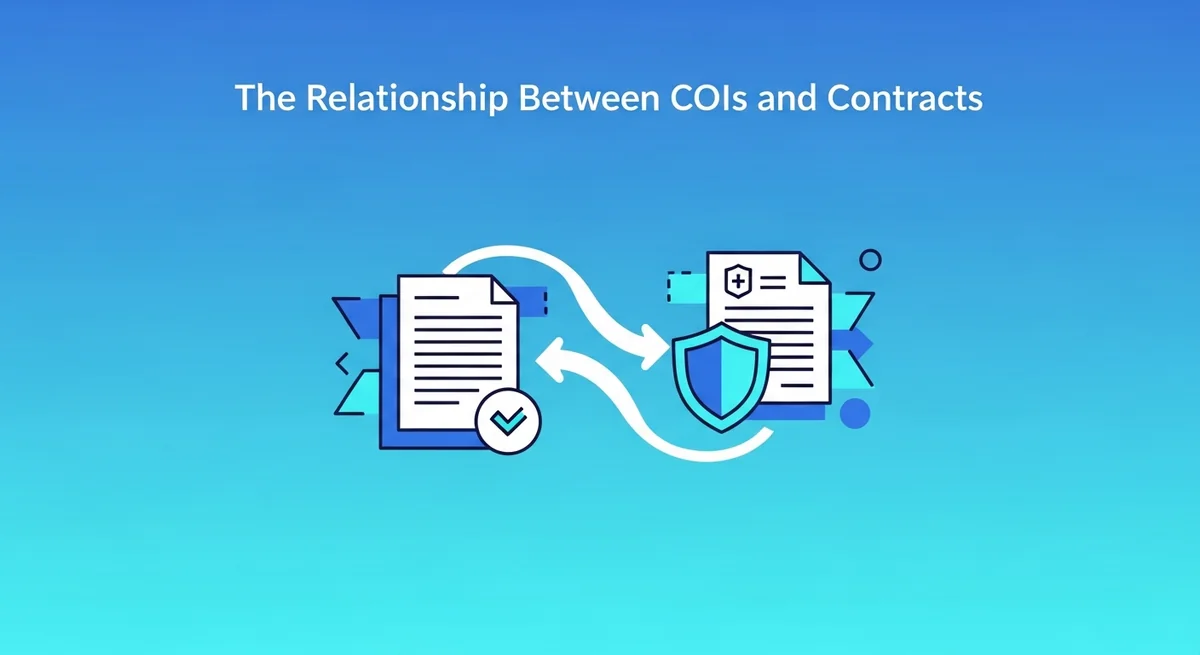
The Relationship Between COIs and Contracts: A Complete Guide
Understanding the relationship between COIs and contracts is essential for protecting your business from liability and ensuring compliance. Certificates of Insurance (COIs) serve as proof that contractual insurance requirements are met, creating a critical link between written agreements and actual coverage. This guide explains how COIs and contracts work together, why this relationship matters, and how to manage both effectively.
In this comprehensive guide, you'll learn the fundamentals of how insurance certificates verify contract compliance, discover step-by-step processes for aligning COIs with contract language, and uncover best practices that prevent costly gaps in coverage. Whether you're a property manager, general contractor, or business owner working with vendors, mastering this relationship protects your organization from financial and legal risks.
Table of Contents
- Understanding the Fundamentals: How COIs and Contracts Connect
- Step-by-Step: Verifying COI Compliance with Contract Requirements
- Best Practices for Managing the COI-Contract Relationship
- Common Mistakes That Create Coverage Gaps
- Key Takeaways
- Frequently Asked Questions
Understanding the Fundamentals: How COIs and Contracts Connect
The relationship between COIs and contracts forms the backbone of business risk management. A contract establishes insurance requirements that vendors, contractors, or service providers must meet. The COI serves as documented proof that these requirements are satisfied before work begins.
What Contracts Specify About Insurance
Business contracts typically include an insurance section that outlines specific coverage requirements. These provisions protect both parties by establishing minimum insurance standards that must be maintained throughout the contract period.
Common contract insurance requirements include:
- Minimum coverage limits for each policy type (general liability, workers compensation, auto liability)
- Additional insured status for the hiring party
- Waiver of subrogation endorsements
- Primary and non-contributory language
- Notice of cancellation requirements (typically 30 days)
For detailed information on these contractual protections, our guide on Understanding Indemnification And Hold Harmless Agreements explains how insurance requirements work alongside indemnification clauses to create comprehensive risk transfer.
What COIs Prove About Coverage
A Certificate of Insurance provides snapshot evidence of active insurance policies. The relationship between COIs and contracts becomes clear when you understand that the COI translates contract language into verifiable insurance details.
The ACORD 25 form, the industry standard COI, displays critical information that corresponds directly to contract requirements. Each section of the form addresses specific contractual provisions, from policy limits to endorsements. Understanding how to read these forms is essential for compliance verification, which is why Acord 25 Certificate Complete Guide provides a comprehensive breakdown of every field.
Why This Relationship Matters Legally
The connection between COIs and contracts carries significant legal weight. Courts have consistently held that certificate holders have the right to rely on COI information when making business decisions. If a COI misrepresents coverage that doesn't actually exist, the certificate holder may face unexpected liability exposure.
This legal importance extends to three key areas:
- Contract breach: Failure to maintain required insurance typically constitutes a material breach of contract, allowing termination and potential damages.
- Liability exposure: Without proper insurance verification, your business may become the primary target in litigation following an incident.
- Due diligence: Courts expect certificate holders to exercise reasonable care in verifying insurance compliance before allowing work to commence.
Step-by-Step: Verifying COI Compliance with Contract Requirements
Properly managing the relationship between COIs and contracts requires a systematic verification process. Follow these steps to ensure complete compliance before work begins.
Step 1: Extract Contract Insurance Requirements
Begin by creating a checklist of all insurance requirements from your contract. Document the specific requirements for each coverage type, including minimum limits, deductibles, and required endorsements.
Create a requirement matrix that includes:
- Required coverage types (general liability, workers comp, auto, professional liability, umbrella)
- Minimum limits for each occurrence and aggregate
- Certificate holder name and address exactly as it should appear
- Required endorsements (additional insured, waiver of subrogation, primary and non-contributory)
- Notice of cancellation period
Step 2: Request the Certificate of Insurance
Submit a clear, detailed COI request to your vendor or contractor. Provide your complete certificate holder information and reference the specific contract that establishes insurance requirements. Include your requirement checklist to eliminate ambiguity.
Best practices for requesting certificates include providing your insurance requirements in writing, setting a clear deadline before work begins, and specifying the exact certificate holder name and address. Many organizations struggle with this process when relying on email, which is why Email Vs Platform Coi Collection compares traditional methods with modern automated approaches.
Step 3: Verify Coverage Limits Match Contract Minimums
Compare each policy's limits shown on the COI against your contract requirements. Check both per-occurrence limits and aggregate limits, as both must meet or exceed contract minimums.
Pay special attention to:
- General liability: Verify both per-occurrence and general aggregate meet requirements
- Auto liability: Confirm combined single limit or split limits satisfy contract language
- Workers compensation: Check statutory limits and employer's liability amounts
- Umbrella coverage: Ensure excess liability provides adequate additional protection
Step 4: Confirm Required Endorsements Are Listed
The relationship between COIs and contracts becomes most critical when verifying endorsements. These policy modifications must appear in the certificate's description of operations or additional remarks section.
Essential endorsement verifications:
- Additional insured status: Look for language like "Certificate holder is additional insured as required by written contract" or specific endorsement form numbers (CG 20 10, CG 20 37)
- Waiver of subrogation: Confirm statement that insurer waives rights of recovery against certificate holder
- Primary and non-contributory: Verify language stating coverage is primary to certificate holder's insurance
- Notice of cancellation: Check that the required notice period (typically 30 days) is specified
Step 5: Verify Certificate Holder Information
Confirm that your organization's name and address appear exactly as specified in the contract in the certificate holder box. Even minor variations can create ambiguity about who is protected under the policy endorsements.
Common certificate holder errors include abbreviated names, outdated addresses, incorrect entity types (LLC vs Inc), and missing suite numbers. These seemingly small details can have major implications during claims, making accuracy essential.
Step 6: Check Policy Effective Dates
Verify that all policies are currently in force and will remain active throughout your contract period. The relationship between COIs and contracts requires continuous coverage, not just insurance that's valid on the start date.
If any policies expire before your contract ends, establish a system to obtain renewal certificates before expiration. Most businesses require updated certificates at least 30 days before policy expiration to ensure no coverage gaps occur.
Step 7: Document Compliance and Deficiencies
Create a written record of your verification process. Document which requirements are met and identify any deficiencies that need correction. This documentation proves due diligence if questions arise later.
If deficiencies exist, communicate them clearly to the vendor with specific instructions for correction. Do not allow work to begin until all contract insurance requirements are fully satisfied and documented with a compliant COI.
Best Practices for Managing the COI-Contract Relationship
Effectively managing the relationship between COIs and contracts requires systematic processes and proactive oversight. These expert recommendations help organizations maintain compliance while minimizing administrative burden.
Standardize Your Contract Insurance Language
Create standardized insurance requirement templates for different vendor categories. Consistency in contract language makes COI verification faster and reduces errors. Work with your legal counsel and insurance broker to develop requirements appropriate for your risk profile.
Standard templates should vary by risk level. A janitorial service requires different coverage than a roofing contractor. Tailor requirements to actual exposure while maintaining consistent language within each category.
Implement Pre-Contract Insurance Review
Review potential vendors' insurance capabilities before finalizing contracts. Some contractors cannot obtain certain coverage types or limits, making contract requirements impossible to fulfill. Early insurance discussions prevent delays and rework.
Ask vendors to provide current COIs during the bidding or proposal stage. This reveals their existing coverage and identifies gaps that need addressing before contract execution. Building an effective insurance compliance program, as detailed in Building An Insurance Compliance Program, includes these pre-qualification steps.
Create a Centralized Tracking System
Maintain a single source of truth for all vendor contracts and corresponding COIs. Whether using spreadsheets or specialized software, centralized tracking ensures no certificates expire unnoticed and all stakeholders access current information.
Your tracking system should link each COI to its governing contract, flag upcoming expirations, and document all compliance verification steps. Many organizations start with spreadsheets but eventually outgrow this approach as vendor counts increase.
Establish Expiration Monitoring Protocols
The relationship between COIs and contracts extends beyond initial verification to ongoing monitoring. Implement automatic reminders at 60, 30, and 15 days before policy expiration. Send renewal requests to vendors with sufficient lead time for their brokers to process updates.
Create escalation procedures for vendors who don't provide renewal certificates. Define when to suspend work privileges due to lapsed coverage. Clear policies protect your organization from the difficult decision of whether to allow uninsured contractors on site.
Verify Certificates Directly With Insurers
For high-risk projects or vendors, verify COI information directly with the insurance carrier or agent. Call the agent listed on the certificate to confirm coverage details, especially endorsements that may not be clearly stated.
This extra step catches fraudulent certificates and identifies situations where certificates misrepresent actual policy terms. While time-consuming, direct verification provides maximum protection for critical vendor relationships.
Train Staff on Compliance Requirements
Everyone involved in vendor management needs basic knowledge of the relationship between COIs and contracts. Train procurement staff, project managers, and accounts payable teams on what constitutes compliant insurance documentation.
Common training topics include reading ACORD forms, identifying deficient certificates, understanding endorsement language, and following escalation procedures. Regular training updates keep compliance top of mind across your organization.
Automate Where Possible
Manual COI tracking becomes unsustainable as vendor counts grow. Modern platforms automate certificate collection, verification, and renewal tracking. Automation reduces human error, saves administrative time, and ensures consistent compliance standards.
Automated systems can extract data from certificates, compare requirements against actual coverage, and alert stakeholders to deficiencies. This technology transforms COI management from reactive to proactive.
Common Mistakes That Create Coverage Gaps
Even experienced professionals make errors when managing the relationship between COIs and contracts. Avoid these common pitfalls that expose organizations to unexpected liability.
Accepting Certificates Without Verification
The most dangerous mistake is filing COIs without comparing them against contract requirements. A certificate in your files means nothing if it doesn't actually satisfy your insurance specifications.
This error typically occurs due to time pressure or lack of training. Staff members assume that receiving a certificate equals compliance, but deficient certificates are extremely common. Always perform line-by-line verification against contract requirements before approving any vendor to begin work.
Ignoring the Certificate Disclaimer Language
Every ACORD certificate contains disclaimer language stating that the certificate doesn't amend, extend, or alter coverage. Many people mistakenly believe that endorsements listed on the COI automatically provide the stated protection.
The certificate only represents what the issuer believes the policy contains. The actual policy governs coverage. This is why verifying endorsements directly with insurers matters for high-risk situations. Understanding these limitations helps manage expectations about what COIs actually prove.
Failing to Monitor Certificate Expirations
Obtaining an initial compliant COI means nothing if coverage lapses mid-contract. Many organizations verify insurance before work begins but never check again. Vendors change carriers, cancel policies, or simply forget to renew coverage.
Without active expiration monitoring, you may have uninsured contractors working on your property for months. Implement calendar reminders or automated tracking to request renewal certificates before expiration. The cost of non-compliance, detailed at The Cost Of Non Compliance Real World Examples, often stems from this preventable mistake.
Overlooking Additional Insured Requirements
Additional insured status is often the most critical endorsement in the relationship between COIs and contracts, yet it's frequently missing or improperly documented. Some certificates state "additional insured as required by written contract" without confirming the actual endorsement exists.
Verify that the specific endorsement form provides the protection you need. Blanket additional insured endorsements may exclude certain operations or limit coverage in ways that don't satisfy your contract. Request copies of actual endorsement forms for important vendor relationships.
Accepting Aggregate Limits That Are Too Low
Many contracts specify per-occurrence limits but forget to address aggregate limits. A policy with adequate per-occurrence coverage but a low aggregate can be exhausted by multiple small claims, leaving nothing available for your claim.
This problem compounds when vendors work for multiple clients simultaneously. Their aggregate limit must cover all clients' exposure, not just yours. Consider requiring higher aggregates or project-specific policies for large contracts.
Misunderstanding Claims-Made vs Occurrence Policies
Professional liability and some general liability policies operate on a claims-made basis rather than occurrence. Claims-made policies only cover claims filed during the policy period, regardless of when the incident occurred.
If a vendor's claims-made policy expires or cancels, you lose coverage for past work unless they maintain tail coverage. Contract language should address this by requiring extended reporting period endorsements or occurrence-based policies for certain coverage types.
Not Addressing Subcontractor Insurance
The relationship between COIs and contracts must extend to subcontractors. Your vendor's insurance may exclude subcontractor operations, leaving you exposed if the sub causes damage or injury.
Contract language should require vendors to obtain certificates from all subcontractors meeting the same insurance requirements. Alternatively, require vendors to carry policies that specifically cover subcontractor operations and provide you with additional insured status for sub activities.
Allowing Work to Begin Before Verification
Business pressure often leads to allowing vendors on site before completing insurance verification. This creates enormous risk. If an incident occurs before you confirm proper coverage, you may have no recourse against the vendor's insurance.
Establish firm policies that no vendor begins work without a verified, compliant COI on file. Build sufficient lead time into your contracting process to obtain and review certificates without delaying project starts.
Key Takeaways
- The relationship between COIs and contracts forms the foundation of business risk management, with contracts establishing requirements and certificates providing proof of compliance.
- Effective verification requires systematically comparing every COI element against specific contract language, including limits, endorsements, and certificate holder information.
- Standardized contract insurance language and centralized tracking systems reduce errors and administrative burden while maintaining consistent compliance.
- Active expiration monitoring prevents coverage gaps that expose your organization to liability from uninsured contractors.
- Common mistakes like accepting unverified certificates, ignoring aggregate limits, and allowing work before compliance confirmation create preventable risks.
- Automation transforms COI management from reactive to proactive, reducing human error while ensuring continuous compliance monitoring.
- Training all stakeholders on insurance compliance requirements ensures consistent application of verification standards across your organization.
Related Resources
- Understanding Indemnification and Hold Harmless Agreements — Learn how insurance requirements work alongside indemnification clauses to create comprehensive contractual risk transfer. Understanding Indemnification And Hold Harmless Agreements
- Building an Insurance Compliance Program — Discover how to create systematic processes for managing vendor insurance requirements from pre-qualification through ongoing monitoring. Building An Insurance Compliance Program
- Ultimate Guide to ACORD 25 Certificates — Master every field on the industry-standard COI form to verify compliance accurately and efficiently. Acord 25 Certificate Complete Guide
- The Cost of Non-Compliance: Real-World Examples — Understand the financial and legal consequences of inadequate insurance verification through actual case studies. The Cost Of Non Compliance Real World Examples
- Manual vs Automated COI Tracking Statistics — Compare the time, cost, and accuracy differences between manual certificate management and automated platforms. Manual Vs Automated Tracking Statistics
Frequently Asked Questions
What happens if a vendor's COI doesn't match contract requirements?
When a COI doesn't satisfy contract requirements, you should not allow the vendor to begin work. Document specific deficiencies in writing and request a corrected certificate from the vendor's insurance agent. Common deficiencies include insufficient limits, missing endorsements, or incorrect certificate holder information. The vendor must obtain proper coverage or endorsements from their insurer before work can commence. Allowing non-compliant vendors on site exposes your organization to liability that you believed was transferred through the contract.
How often should I verify vendor insurance during long-term contracts?
You should obtain updated certificates before each policy expiration date throughout the contract term. Most commercial insurance policies renew annually, requiring annual certificate updates. Implement a tracking system that alerts you 60 and 30 days before expiration so you can request renewal certificates with adequate lead time. For multi-year contracts, never assume insurance remains in force without verification. Vendors change carriers, cancel policies, or fail to renew coverage. Continuous monitoring protects you from coverage gaps that violate the relationship between COIs and contracts.
Can I rely on the information shown on a Certificate of Insurance?
Certificates provide evidence of coverage but include disclaimer language stating they don't amend or alter the actual policy. The COI represents what the issuing agent believes the policy contains based on their records. For routine vendor relationships, certificates provide reasonable assurance of compliance. However, for high-risk projects or critical vendors, consider verifying coverage details directly with the insurance carrier. Request copies of actual policy endorsements for additional insured and waiver of subrogation provisions. While COIs serve as practical proof in most situations, understand their limitations and verify directly when stakes are high.
What's the difference between being named as certificate holder versus additional insured?
Being named as certificate holder means you receive the COI for informational purposes, but this provides no insurance protection. Additional insured status extends the vendor's liability coverage to protect you from claims arising from the vendor's work. This is a critical distinction in the relationship between COIs and contracts. Your contract should require both: certificate holder status so you receive documentation, and additional insured endorsements so you gain actual coverage under their policy. Without additional insured status, you must rely entirely on your own insurance if the vendor's work causes injury or damage, even when the vendor is at fault.
Should my contract specify exact insurance policy form numbers or endorsements?
Specifying exact endorsement forms (like CG 20 10 or CG 20 37 for additional insured) provides clarity but may create problems if vendors use non-standard carriers with different form numbers. A better approach combines outcome-based language with form examples. For instance, require "additional insured status for ongoing and completed operations via endorsement such as CG 20 10 or equivalent." This gives vendors flexibility while clearly communicating your requirements. Work with your insurance broker and legal counsel to develop contract language that achieves your risk transfer goals without unnecessarily limiting vendor insurance options. The substance of coverage matters more than specific form numbers.
Conclusion
Mastering the relationship between COIs and contracts protects your organization from liability while ensuring vendors maintain required insurance throughout your business relationship. By implementing systematic verification processes, standardizing contract language, and monitoring certificate expirations, you transform insurance compliance from a paperwork burden into a strategic risk management tool.
The key to success lies in understanding that certificates and contracts work together as a complete system. Contracts establish your insurance requirements, COIs prove compliance, and ongoing monitoring ensures continuous protection. When you manage this relationship effectively, you minimize exposure to preventable risks while building stronger, more professional vendor relationships.
Start your free trial of PolicyManagerHub today to automate COI tracking, ensure contract compliance, and eliminate the manual burden of insurance verification. Our platform streamlines the entire process from certificate collection through expiration monitoring, giving you confidence that your vendor insurance requirements are always satisfied.
CoverLedger Editorial Team
Expert insights on insurance compliance, COI tracking, and risk management from the CoverLedger team.
Related Articles

Construction Project Insurance Coverage Layers
Construction projects involve significant financial risk, complex liability exposures, and multiple parties working simultaneously. Understanding construction project insurance coverage layers is essential for protecting your business from catastrophic losses. This comprehensive guide explains how insurance layers work, why they matter, and how to structure adequate protection for projects of any size.
Subcontractor Insurance: What GCs Need to Verify
As a general contractor, you face significant liability exposure when subcontractors work on your projects. Without proper insurance verification, you could be held responsible for accidents, property damage, or injuries caused by subs. This comprehensive guide covers everything about subcontractor insurance: what GCs need to verify to protect their business, reduce risk, and maintain compliance.
Insurance Requirements for General Contractors
General contractors face unique liability exposures that require comprehensive insurance coverage. Whether you're building residential homes, commercial properties, or managing multiple subcontractors, understanding insurance requirements for general contractors is essential to protect your business, comply with contracts, and avoid costly gaps in coverage.