Umbrella Insurance vs Excess Liability: Key Differences Explained
When it comes to protecting your assets and financial future, understanding the difference between umbrella insurance vs excess liability coverage is crucial. While these terms are often used interchangeably, they represent distinct insurance products with important variations in coverage scope, triggers, and applications. This comprehensive guide breaks down the key differences, helping you make informed decisions about which type of extended liability coverage best suits your specific needs.
Umbrella Insurance vs Excess Liability: Key Differences Explained
When it comes to protecting your assets and financial future, understanding the difference between umbrella insurance vs excess liability coverage is crucial. While these terms are often used interchangeably, they represent distinct insurance products with important variations in coverage scope, triggers, and applications. This comprehensive guide breaks down the key differences, helping you make informed decisions about which type of extended liability coverage best suits your specific needs.
Table of Contents
- The Fundamentals of Extended Liability Coverage
- Umbrella Insurance: Comprehensive Protection
- Excess Liability: Focused Coverage Extension
- Key Differences Between Umbrella Insurance vs Excess Liability
- How to Choose Between Umbrella and Excess Liability Coverage
- Common Mistakes to Avoid
- Key Takeaways
- Frequently Asked Questions
The Fundamentals of Extended Liability Coverage
Before diving into the umbrella insurance vs excess liability comparison, it's important to understand why extended liability coverage matters. Standard liability policies—whether homeowners, auto, or business insurance—have coverage limits that may be insufficient in today's litigious society.
Extended liability coverage provides an additional layer of protection that kicks in when your primary insurance policy's limits are exhausted. This extra protection can be the difference between financial security and financial ruin in the event of a major lawsuit or catastrophic claim.
Why Extended Coverage Is Essential
Lawsuit settlements regularly exceed standard policy limits
Personal assets are at risk without adequate coverage
Medical costs and legal fees can quickly escalate
Extended coverage is surprisingly affordable relative to the protection provided
Now, let's examine the two primary types of extended liability coverage: umbrella insurance and excess liability policies.
Umbrella Insurance: Comprehensive Protection
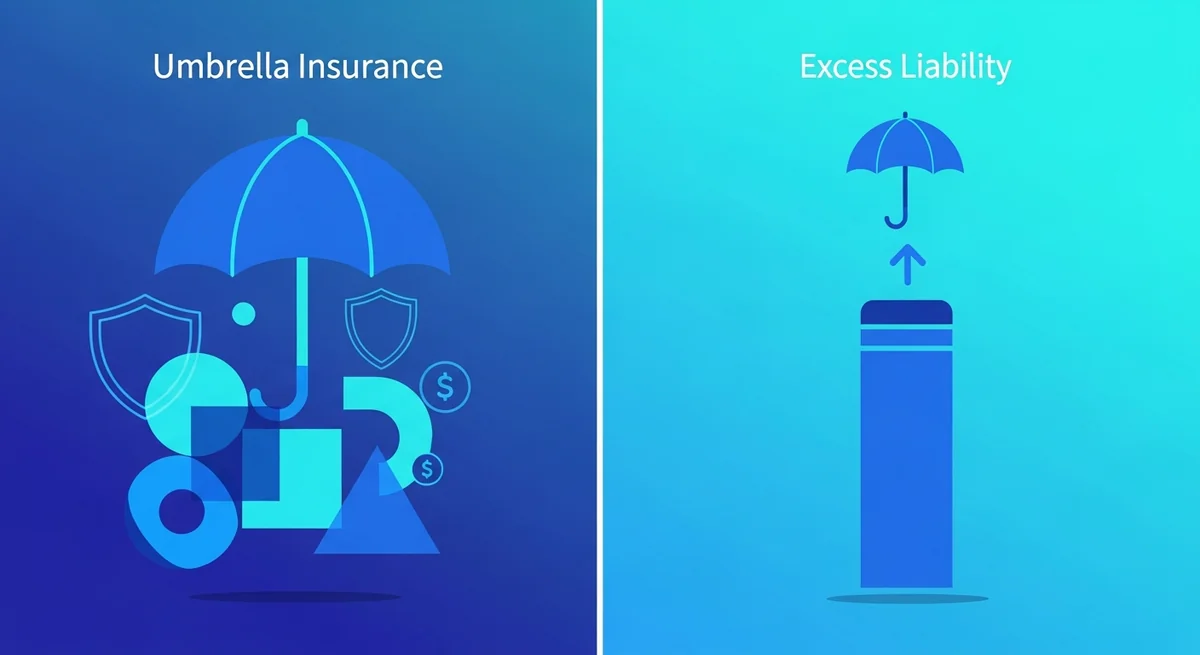
Umbrella insurance is aptly named—it spreads protection over multiple aspects of your life or business, providing broad coverage beyond what your underlying policies offer. This type of extended coverage doesn't just increase limits; it often fills gaps and provides protection for scenarios that might not be covered by standard policies.
Key Features of Umbrella Insurance
Provides coverage across multiple primary policies (auto, home, boat, etc.)
Offers broader protection, including some claims not covered by underlying policies
Typically covers libel, slander, false imprisonment, and other personal injury claims
May provide coverage worldwide (important for international travelers)
Usually includes legal defense costs, even if a lawsuit is groundless
For example, if you're sued for $1 million after an auto accident, and your auto insurance only covers $300,000 in liability, your umbrella policy would cover the remaining $700,000 (assuming you have sufficient umbrella coverage). But umbrella insurance goes further—it might also cover you if you're sued for defamation on social media, which your homeowner's policy might exclude.
Excess Liability: Focused Coverage Extension
Unlike the broad protection of umbrella insurance, excess liability coverage is more targeted. It specifically extends the limits of an existing policy without expanding the scope of what's covered. Think of it as adding more of the same coverage rather than adding new types of coverage.
Key Features of Excess Liability
Typically applies to a single underlying policy
Follows the terms and conditions of the underlying policy exactly
Does not provide coverage for claims excluded by the primary policy
Often used by businesses for specific high-risk exposures
May have more favorable pricing for focused coverage needs
For instance, a business with a commercial general liability policy with $1 million in coverage might add an excess liability policy for an additional $5 million. If the business faces a $3 million lawsuit covered by the general liability policy, the primary policy would pay the first $1 million, and the excess policy would cover the remaining $2 million.
Key Differences Between Umbrella Insurance vs Excess Liability
Understanding the umbrella insurance vs excess liability distinction requires examining several key factors. Here's a detailed breakdown of their differences:
1. Coverage Breadth
Umbrella Insurance: Provides broad coverage across multiple underlying policies and often fills gaps by covering claims not included in primary policies.
Excess Liability: Strictly follows the coverage terms of the underlying policy, adding only additional limits without expanding what's covered.
2. Policy Attachment
Umbrella Insurance: Can attach to multiple underlying policies simultaneously (auto, home, watercraft, etc.).
Excess Liability: Typically attaches to a single specific policy and applies only to claims covered by that policy.
3. Gap Coverage
Umbrella Insurance: Often provides first-dollar coverage for certain claims not covered by underlying policies (subject to a self-insured retention, similar to a deductible).
Excess Liability: Does not fill coverage gaps; if the primary policy doesn't cover it, neither does the excess policy.
4. Self-Insured Retention (SIR)
Umbrella Insurance: May include an SIR for claims not covered by underlying policies, typically $10,000 or less for personal policies.
Excess Liability: Generally doesn't have an SIR since it only responds to claims already covered by the underlying policy.
5. Defense Costs
Umbrella Insurance: Typically covers legal defense costs, often outside the policy limits, providing additional value.
Excess Liability: Usually follows the defense provisions of the underlying policy; if the primary policy includes defense costs within limits, so will the excess policy.
6. Common Applications
Umbrella Insurance: Most commonly used by individuals and families seeking comprehensive personal liability protection across all aspects of life.
Excess Liability: Frequently used by businesses for specific high-risk exposures or to meet contractual requirements for higher coverage limits.
This umbrella insurance vs excess liability comparison highlights that while both provide additional liability protection, they function quite differently in practice. Understanding these differences is essential when selecting the right coverage for your specific situation.
How to Choose Between Umbrella and Excess Liability Coverage
Deciding between umbrella insurance vs excess liability coverage requires careful consideration of your specific needs and circumstances. Here's a step-by-step approach to making the right choice:
Step 1: Assess Your Risk Exposure
Identify high-risk activities (hosting gatherings, owning rental properties, serving on boards)
Evaluate your asset portfolio (the more assets you have, the more protection you need)
Consider your lifestyle (frequent entertaining, teenage drivers, pool ownership)
Step 2: Review Your Current Coverage
Examine liability limits on all existing policies
Identify any coverage gaps in your current policies
Note exclusions that might leave you vulnerable
Step 3: Consider These Guidelines
Choose Umbrella Insurance when:
You need protection across multiple aspects of your life (home, auto, boat, etc.)
You're concerned about personal injury claims like libel, slander, or defamation
You travel internationally and want worldwide coverage
You want broader protection that might cover scenarios your primary policies exclude
Choose Excess Liability when:
You need higher limits for a specific policy or exposure
Your underlying policy already provides the scope of coverage you need
You're a business owner with specific high-risk exposures
You need to meet contractual requirements for higher liability limits
Step 4: Consult with an Insurance Professional
An experienced insurance agent or broker can provide invaluable guidance when choosing between umbrella insurance vs excess liability coverage. They can:
Analyze your specific risk exposures
Identify potential coverage gaps
Compare policy options from different insurers
Help determine appropriate coverage limits
The umbrella insurance vs excess liability decision ultimately depends on your unique situation and the specific risks you face. For most individuals and families, umbrella insurance offers the most comprehensive protection, while businesses might benefit from the targeted approach of excess liability policies for specific exposures.
Common Mistakes to Avoid
When navigating the umbrella insurance vs excess liability decision, avoid these common pitfalls:
1. Underestimating Liability Needs
Many people purchase insufficient coverage, leaving assets vulnerable. A good rule of thumb is to have extended liability coverage at least equal to your net worth, but preferably more. Consider potential future earnings that could be garnished in a judgment as well.
2. Assuming All Extended Coverage Is the Same
As our umbrella insurance vs excess liability comparison shows, these policies function quite differently. Don't assume they're interchangeable. Read policy terms carefully and understand exactly what's covered and what's excluded.
3. Overlooking Underlying Insurance Requirements
Both umbrella and excess liability policies require minimum underlying coverage limits. If your primary policies don't meet these requirements, you might have a coverage gap. Always ensure your underlying policies meet or exceed the required limits.
4. Focusing Solely on Price
While cost is important, it shouldn't be the only factor. The cheapest policy might have significant exclusions or limitations. Compare policy terms, not just premiums. Extended liability coverage is relatively inexpensive for the protection provided—a $1 million umbrella policy often costs just $150-300 annually.
5. Failing to Update Coverage as Circumstances Change
Life changes—you may acquire more assets, start a business, or take on new activities with additional liability exposure. Review your umbrella insurance vs excess liability needs annually and after major life events to ensure continued adequate protection.
Key Takeaways
Umbrella insurance provides broad coverage across multiple policies and often fills coverage gaps, while excess liability strictly follows the underlying policy's terms.
Umbrella policies typically cover claims not included in primary policies, such as libel, slander, and false imprisonment.
Excess liability policies are usually more focused, extending limits for a specific policy without expanding coverage scope.
Most individuals and families benefit from umbrella insurance's comprehensive approach.
Businesses often utilize excess liability for specific high-risk exposures or to meet contractual requirements.
Extended liability coverage is relatively affordable compared to the protection it provides.
Consulting with an insurance professional helps ensure you select the right type and amount of coverage for your specific situation.
Frequently Asked Questions
What is the main difference between umbrella insurance and excess liability coverage?
The primary difference between umbrella insurance vs excess liability coverage is in their scope and function. Umbrella insurance provides broader protection across multiple policies and often covers claims not included in underlying policies. Excess liability simply extends the limits of a specific underlying policy without expanding what's covered, following exactly the same terms and conditions as the primary policy.
How much umbrella or excess liability coverage do I need?
The amount of coverage you need depends on your assets, income, and risk exposure. A general recommendation is to have extended liability coverage at least equal to your net worth. However, many financial advisors suggest having coverage that exceeds your net worth to protect future income and account for legal defense costs. Most personal umbrella policies start at $1 million in coverage and increase in million-dollar increments.
Are umbrella insurance and excess liability policies expensive?
Extended liability coverage is surprisingly affordable relative to the protection it provides. A $1 million personal umbrella policy typically costs between $150 and $300 annually. Each additional million in coverage usually adds $75-$100 per year. Excess liability policies for businesses vary more widely in price, depending on the industry, exposure, and coverage limits. The cost-benefit ratio makes extended liability coverage one of the most valuable insurance purchases for protecting your financial future.
Can I have both umbrella insurance and excess liability coverage?
Yes, it's possible to have both types of coverage, especially for those with complex insurance needs. For example, a business owner might have a personal umbrella policy for comprehensive personal protection while also maintaining excess liability coverage for specific business exposures. However, it's important to work with an insurance professional to ensure policies are structured properly and avoid overlapping coverage that you're paying for twice.
Do umbrella and excess liability policies cover intentional acts?
Generally, neither umbrella insurance nor excess liability policies cover intentional acts, criminal behavior, or expected/intended harm. Both types of policies are designed to protect against unexpected and unintentional incidents. Additionally, most extended liability policies exclude business activities (unless specifically designed for business), professional liability, and certain high-risk activities unless specifically endorsed.
Conclusion
Understanding the umbrella insurance vs excess liability distinction is crucial for creating a comprehensive risk management strategy. While both provide extended liability protection beyond your primary insurance policies, they function differently in important ways.
Umbrella insurance offers broad protection across multiple aspects of your life, often filling coverage gaps and providing protection for scenarios not covered by standard policies. Excess liability provides focused coverage extension, strictly following the terms of your underlying policy without expanding what's covered.
For most individuals and families, umbrella insurance provides the most comprehensive protection. For businesses with specific high-risk exposures, excess liability policies may be more appropriate. Many people find that the relatively low cost of extended liability coverage makes it one of the most valuable insurance investments they can make to protect their financial future.
Ultimately, the right choice depends on your specific situation, risk exposure, and coverage needs. Consulting with an experienced insurance professional can help you navigate the umbrella insurance vs excess liability decision and ensure you have the appropriate protection in place.
Get started with automated insurance compliance today by exploring how PolicyManagerHub can help you track and manage all your insurance policies, including umbrella and excess liability coverage, in one centralized platform.
Related Insurance Coverage Resources
For a broader overview, see our guide on What Is Umbrella Insurance at What Is Umbrella Insurance. If you're deciding between umbrella and excess coverage, our side-by-side comparison at Umbrella Vs Excess Liability breaks down the 5 key differences. For cost data, check How Much Umbrella Insurance Do I Need at How Much Umbrella Insurance Do I Need.
CoverLedger Editorial Team
Expert insights on insurance compliance, COI tracking, and risk management from the CoverLedger team.
Related Articles

Construction Project Insurance Coverage Layers
Construction projects involve significant financial risk, complex liability exposures, and multiple parties working simultaneously. Understanding construction project insurance coverage layers is essential for protecting your business from catastrophic losses. This comprehensive guide explains how insurance layers work, why they matter, and how to structure adequate protection for projects of any size.
Subcontractor Insurance: What GCs Need to Verify
As a general contractor, you face significant liability exposure when subcontractors work on your projects. Without proper insurance verification, you could be held responsible for accidents, property damage, or injuries caused by subs. This comprehensive guide covers everything about subcontractor insurance: what GCs need to verify to protect their business, reduce risk, and maintain compliance.
Insurance Requirements for General Contractors
General contractors face unique liability exposures that require comprehensive insurance coverage. Whether you're building residential homes, commercial properties, or managing multiple subcontractors, understanding insurance requirements for general contractors is essential to protect your business, comply with contracts, and avoid costly gaps in coverage.